
Share
Valuing ownership interests in early-stage real estate development projects requires discipline, economic clarity, and a careful understanding of how risk evolves over time. Too often, development-stage interests are treated as if they exist in a static condition of heightened uncertainty simply because construction has not yet been completed. That framing is incomplete. Development risk is not binary – it is dynamic, milestone-driven, and progressively reduced over time. Valuation approaches that fail to reflect this progression risk producing conclusions that are economically inconsistent with how investors actually price these assets.
When capital is first raised for a development project, risk is typically at its highest point. During conceptual underwriting and feasibility analysis, investors are evaluating projections, preliminary budgets, and assumptions that remain subject to regulatory approval, financing availability, and execution feasibility. Land may not yet be fully controlled, entitlements may be pending, construction pricing may not be locked, and financing may be indicative rather than committed. At this stage, investors demand elevated target returns precisely because multiple layers of uncertainty remain unresolved.
As the project advances, that uncertainty does not remain constant. Site control eliminates acquisition uncertainty, entitlements reduce regulatory risk, binding debt commitments mitigate capital availability concerns, execution of guaranteed maximum price contracts narrows cost-overrun exposure, and full equity funding eliminates fundraising risk. Each milestone removes a discrete layer of risk and uncertainty that was previously embedded in required returns. When uncertainty declines and projected economics remain intact, required rates of return compress. If expected cash flows are unchanged, value logically increases as risk is reduced.
Why construction alone does not justify steep discounts
Despite this progression, it is sometimes suggested that once a project is under construction, the equity should be significantly discounted because of “construction risk.” That position oversimplifies the risk profile. A project that has secured land, obtained permits, closed on construction financing, fully raised equity, and commenced vertical development is materially less risky than it was at inception. Construction risk – while real – typically consists of execution risk, schedule risk, and budget performance within a defined framework.
Valuation discipline in estate and gift planning
This analytical framework becomes especially important in estate and gift planning contexts. In recent years, there has been a noticeable increase in transfers of early-stage development interests as part of intergenerational wealth planning. The rationale is understandable. Development projects often experience meaningful appreciation upon successful completion and stabilization. Transferring interests earlier in the lifecycle may shift future appreciation to the next generation while potentially minimizing use of lifetime exemption amounts. From a planning standpoint, such strategies may be entirely appropriate.
However, valuation discipline does not change simply because a transfer is tax-motivated. Fair market value remains defined under Revenue Ruling 59-60 as the price at which property would change hands between a hypothetical willing buyer and a willing seller, where: (i) both parties have reasonable knowledge of all relevant facts and are acting in their respective best interests and (ii) neither party is under any compulsion to buy or sell. The ruling emphasizes consideration of the nature of the business, its financial condition, earning capacity, and, importantly, actual arm’s-length transactions involving the subject interest. Statement on Standards for Valuation Services No. 1 similarly requires that the analyst consider relevant data and avoid unsupported assumptions. These principles are especially critical when a valuation is performed shortly after capital formation.
The importance of market evidence – and the risk of double counting
If, for example, equity was raised in June at negotiated arm’s-length pricing among informed investors who fully understood development risk, and a gift valuation is performed in November, the presence of a recent transaction becomes highly probative. Investors who contributed capital were aware that the funds would be deployed into a development project subject to construction risk, financing risk, illiquidity, and minority position constraints. Those risks were not newly discovered after closing; they were the foundation of the pricing decision.
To conclude that the same interest is materially worth less only months later, solely because construction has commenced, requires a compelling economic explanation. Absent a material intervening event such as cost overruns, financing deterioration, entitlement loss, or adverse market shifts, discounting below recent subscription pricing risks double counting uncertainties that investors explicitly accepted and priced only months earlier.
Illiquidity and the myth of “no market”
Another common argument in support of steep discounts is the perceived absence of a secondary market for early-stage development interests. Clients sometimes assert that because minority interests in projects under construction rarely trade, there must be “no market,” and therefore significant discounts are justified. That reasoning conflates illiquidity with lack of value. This is a critical distinction that is often misunderstood in practice. The more analytically sound question is not whether transactions are occurring, but why they are not occurring.
Development capital is intentionally patient capital. Investors contribute funds with the expectation of remaining invested through completion, lease-up, stabilization, and eventual exit via refinance or sale. An investor who contributes capital in June is not entering the transaction with a November exit strategy in mind. The absence of secondary transactions during the natural lock-in period of a development project often reflects alignment with the originally contemplated hold period, not a lack of economic value. Lack of observed trades is not evidence that no buyer would exist at a market-clearing price. It may simply reflect transfer restrictions, sponsor consent requirements, lender approval provisions, or investor preference to remain invested until the business plan has been executed.
It is important not only to recognize the difference between a lack of evidence and evidence demonstrating the absence of value, but – more critically – to avoid conflating the former with the latter. The fair market value standard assumes a hypothetical willing buyer and willing seller. It does not require proof that frequent transactions occur. Many valuable assets trade infrequently. Illiquidity may justify a marketability discount, but the magnitude of that discount must be grounded in empirical analysis and must reflect the actual expected holding period. Penalizing an investment for behaving exactly as designed – remaining illiquid during construction – does not align with economic reality.
Limitations of liquidation-based valuation approaches
A related analytical shortcut is the reliance on a hypothetical liquidation approach as a primary valuation framework. Under this framework, the analyst asks what each equity layer would receive if the project were liquidated immediately during construction. While liquidation analysis can serve as a sensitivity, it should not define valuation unless distress or abandonment is a realistic outcome. No investor contributed capital assuming that the project would be liquidated mid-construction. The investment thesis was based on completion, stabilization, and realization of projected cash flows. To disregard that income-based framework and value the interest solely on a forced liquidation premise ignores the economic basis upon which capital was raised.
The distortion becomes particularly evident when examining general partner promote or carried interest structures. In many development partnerships, sponsors participate only after preferred returns and capital have been returned to limited partners. Under a hypothetical mid-construction liquidation scenario, the promote layer might receive nothing. Yet it is difficult to find evidence in the marketplace that a sponsor would transfer its promote interest for zero consideration while the project remains on track. The sponsor’s entitlement to future upside is tied to the successful execution of the development plan. That contingent upside is precisely what motivated the sponsor to assemble the site, secure entitlements, raise capital, and manage execution. A liquidation-only framework artificially suppresses that economic potential unless distress or abandonment is probable.
None of this suggests that liquidation analysis is irrelevant. If a project faces credible abandonment risk, financing failure, or material impairment, a liquidation premise may be appropriate. Professional standards require that valuation reflect known or knowable conditions as of the valuation date. But where development is proceeding consistent with the business plan, the valuation premise should reflect continuation, not premature termination.
Aligning valuation with economic reality
Ultimately, valuation must mirror how informed market participants analyze development opportunities. When capital is raised, investors price risk based on forward-looking income expectations. As milestones are achieved, uncertainty declines. Recent arm’s-length transactions provide powerful evidence of value. Illiquidity during the intended hold period does not equate to worthlessness; And hypothetical liquidation during construction does not define economic reality in a non-distressed project.
A defensible and coherent valuation framework
Early-stage development interests can be effective vehicles for intergenerational wealth transfer but fair market value must be grounded in disciplined analysis. Professional standards do not prohibit discounts. They require that discounts be supported, coherent, and economically justified.
Critically, any value conclusion should be tested against the implied yield on equity at the concluded value to make sure that construction and development risk has not been overstated.
When investors subscribe to a development partnership at arm's-length pricing, they do so with full knowledge that the project will enter construction, that capital will be illiquid during the build period, and that cash flow realization is contingent on successful completion and stabilization. Construction risk is not a condition that emerges after closing – it is the central premise of the investment and is already embedded in the return expectations that informed the original pricing.
To then conclude, months later, that the interest has materially declined in value solely because the project is now under construction is to penalize the investment for doing exactly what it was designed to do.
If the project is progressing on schedule and on budget, with no material adverse change in market conditions, financing, or entitlements, the burden falls on the analyst to explain what economic event justifies a departure from the pricing established by informed participants.
A valuation that applies elevated discount rates to capture construction and lease-up risk in the projected cash flows, and then applies further entity-level discounts that implicitly reflect the same uncertainties, risks producing an implied return requirement that no rational market participant would demand for a performing development asset – a clear signal that risk has been double-counted.
In real estate, where risk is progressively retired as milestones are achieved and where the capital stack directly governs cash flow priority, this type of cross-check is not merely academic, it is essential to producing a conclusion that a hypothetical willing buyer would find credible.
A defensible valuation tells a consistent story; one that aligns milestone-based risk progression, market evidence, income expectations, and the legal rights of the equity holder into a conclusion that reflects economic substance rather than opportunistic interpretation.
An illustrative example
The implications of this framework are best illustrated in a practical context (This example is provided solely for illustrative purposes and is not based on any specific transaction, client engagement, or actual events. Any resemblance to real projects or circumstances is purely coincidental.):
Consider a multifamily development where equity is raised in June 2025 at par, based on a conventional development pro forma assuming a three‑year hold, stabilized assumptions and cap rates supported by market conditions, and a target IRR that compensates investors for entitlement, construction, lease‑up, and exit risk. At the time of closing, investors understand that the project is illiquid, subject to construction risk, and dependent on future market conditions. These risks are embedded in the underwriting and reflected in the required return.
By November 2025, the project has achieved several milestones: land acquisition has closed, entitlements are in place, construction financing has been executed, and a guaranteed maximum price contract has been signed in line with initial underwriting budgets. No adverse events have occurred, and projected cash flows remain unchanged. While construction is underway and the investment remains illiquid, several key sources of uncertainty have been eliminated.
In this context, concluding that the same equity interest is worth materially less than its recent subscription price – absent new negative information – requires the analyst to identify which risks have increased since the initial investment date. Applying an incremental discount, simply because construction has commenced, may result in double counting risks that investors explicitly accepted and priced only months earlier. A defensible valuation would instead consider how milestone achievement affects required rates of return. Refer below:
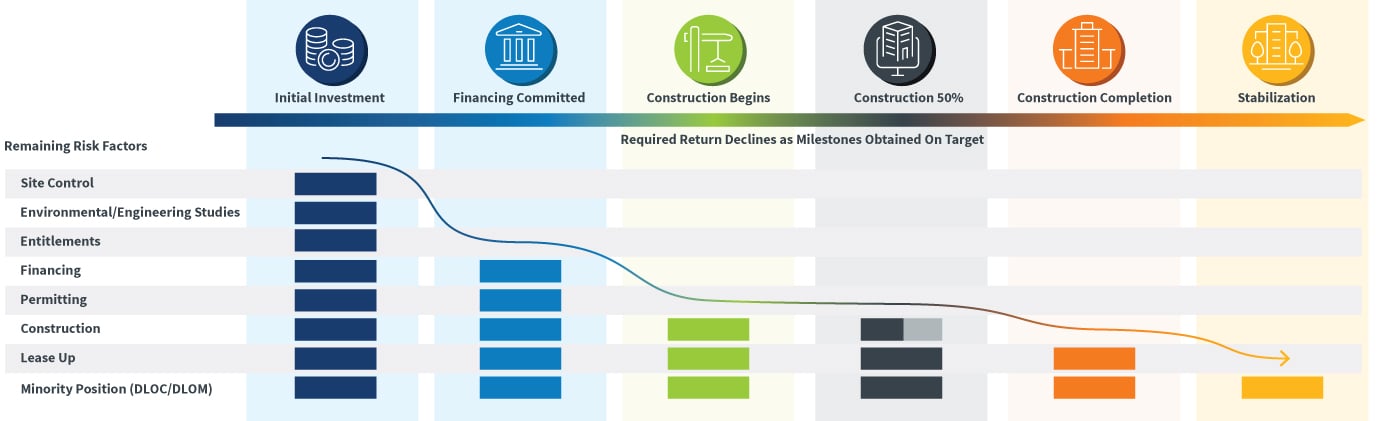
This example highlights the central issue: absent new negative information, applying incremental discounts to subscription pricing simply because development has progressed risks distorting value rather than refining it.
Grounding valuation conclusions in economic reality
Appropriately supported discounts may still be significant; our focus is making sure they are analytically defensible and aligned with how market participants would price the interest. Given the technical and fact-specific nature of these valuations, engaging seasoned professionals is essential to developing an analysis that is rigorous, well documented, and defensible under IRS scrutiny. Our team brings deep experience valuing complex real estate development interests across estate and gift planning contexts, and applying a disciplined approach grounded in market evidence, partnership economics, and applicable professional standards. We are available to support clients and their advisors in performing these analyses, and in preparing clear workpapers and reports that withstand review.
David Emma
Manager, Value360 - Valuation AdvisoryRelated services
Our solutions are tailored to each client’s strategic business drivers, technologies, corporate structure, and culture.
Receive CohnReznick insights and event invitations on topics relevant to your business and role.
Any advice contained in this communication, including attachments and enclosures, is not intended as a thorough, in-depth analysis of specific issues. Nor is it sufficient to avoid tax-related penalties. This has been prepared for information purposes and general guidance only and does not constitute legal or professional advice. You should not act upon the information contained in this publication without obtaining specific professional advice specific to, among other things, your individual facts, circumstances and jurisdiction. No representation or warranty (express or implied) is made as to the accuracy or completeness of the information contained in this publication, and CohnReznick, its partners, employees and agents accept no liability, and disclaim all responsibility, for the consequences of you or anyone else acting, or refraining to act, in reliance on the information contained in this publication or for any decision based on it.